Wednesday, May 8, 2013
Catch up time!
Catching up for me means actually paying attention to my own running again! The overuse injury from last season kind of put me into a mindset where I focused on everything BUT my own running. I volunteered at the Ranch Aid Station for the Buffalo 100, and then spent a ton of energy working on organizing this year's Salt Flats 100 (report in the next blog post). That said, I'm plugging away again, putting miles in wherever I can squeeze them in. This last Saturday I joined Davy Crockett entering as solo runners in a local 50 mile relay race (patterned after the Ragnar Relays) that roughly followed the Denver/Rio Grande rail trail, Legacy Parkway trail, and Jordan River Parkway trail from Roy, UT, to West Jordan, UT. The two of us stood at the start rigged to pretty much self-support the entire 50 miles, surround by people in costumes, team shirts, and carrying a hand-bottle if anything at all. To say we were conspicuous would be an understatement.
Davy has already had an amazing running year and it was only May 4th. I on the other hand had only had a few decent runs, and was mainly relying on short-ish lunch runs as my main training body. We queued up at the start and walked forward until the guy with the clock entered our bib number and yelled "Go!". Davy held back for the first mile and we chatted about the last couple of weeks (where he'd run a 104 mile 24hr race on the west coast, then run my Salt Flats 100, and was now running this 50 miler), but after realizing I was at an entirely different level of training, he excused himself and opened it up. He ended up beating about 1/2 of the relay teams.
I on the other hand, plodded along slowly, hanging with the slowest of the relay teams, and pretty much enjoying the fact that I was on my first real long run. The first "exchange" for the relay at 6.5 miles had water right at the exchange (as expected), and I filled up all my bottles, pulled a PB&J slice out of my pack, and headed out again. They had volunteers posted at several key, and quite odd intersections/course deviations where we literally ran through some parking lots, up alley's behind manufacturing plants, and then joined the formal trail again.
After another 6 miles or so, the next exchange appeared, but no water was in sight... I still had about half of my water, so I chose to head out for the next section. Of course this is when the morning coolness started to wane and I really started drinking. With still two or so miles to go, I was bone dry. By the time I hit the third exchange at about 20.5 miles, I was parched. I refilled there (thanks to Davy who had arrived there to no water, after passing through #2 like I did without filling up and pretty much demanded they get some water there) grabbed more food from my pack, and headed out again. I was pounding the water, and I'd finished my main bottle after only a mile and a half, so I started looking for options. I saw a soccer park with a pavilion off the side of the trail, so I ran to that and found a drinking fountain! I topped off and headed out again. By the 4th exchange at 27 miles, I was starting to feel hydrated again despite finishing all my water before arriving, but was also noticing that my legs were losing energy.
After refilling and refueling, I set off for the next section which ran through the Rose Park section of Salt Lake City. This area has a reputation for being a not-so-nice area of town, and the ever increasing spray paint "art" seemed to be confirming that. The course had been marked with yellow spray-chalk up to this point, and as I ran the trail "ended" and became sidewalk with a couple direction options. No chalk marking here, so I chose the largest of the sidewalk options, and continued running that, passing over several roads, and then was spit out into a parking lot behind a trailer park. This seemed a bit odd, so I back tracked for a mile or so looking for where I'd missed the markings... but to no avail.
I then decided to try another direction at the previous "large" intersection, but this simply spit me out into a neighborhood after less than a 1/2 mile. Back again, and tried the other direction, which ended on the far side of a baseball park and amidst the parking lot full of little-leaguers... nope. I retraced and again followed my original route to see if I'd somehow missed some markings, but after arriving again at the parking lot behind the trailer park without seeing any markings, I figured I must be thoroughly lost. I decided to follow the fence line on the other side of the parking lot as it looked like it had a gate... which sure enough had a chalk marking pointing the opposite direction I was going! Doh!
At this point my GPS was showing 36.5 miles (I should have been at the next exchange by now). My legs were increasingly tightening up, and even my old injury was starting to make itself known, so I decided to call it a day.
All in all, it was my first real long run of the year, and it definitely felt good for most of those miles, so I'll call it a successful Saturday run!


Monday, October 22, 2012
2012 Pony Express 100 Race Report
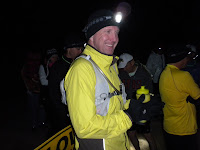
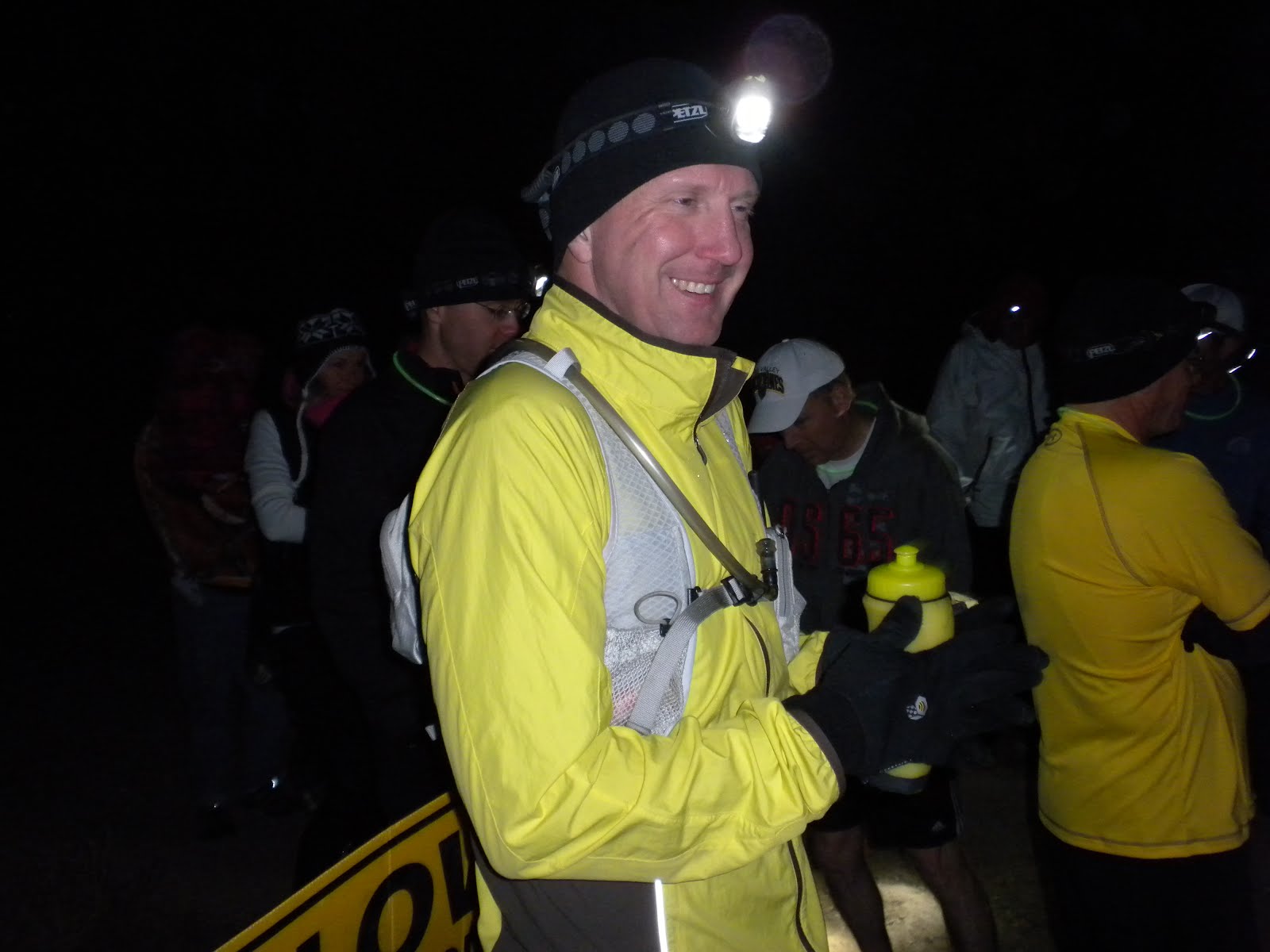
The Pony Express 100 Mile Endurance Run has been on my list since meeting Davy Crockett and this year was the year. My wife and I awoke at 3:00AM and loaded the truck with all the necessary gear (as this is a self-supported event), and we headed towards Faust Utah. We arrived just in time to see the early start group heading out of the start chute, and I walked to the sign-in tent, picked up my race-bag, and headed back to the warmth of the truck.
At 0550, Davy called out for the runners to report to the start, and the handful of
us starting at 0600 formed a gaggle at the start chute and Davy briefed us on the last
minute details, and then counted down for the start.
 As I left the start I locked into my pace and held it despite the easy grade and classic "group enthusiasm" at the beginning of a race. My epic fail at the Wasatch 100 was fresh in my mind so I disciplined myself to stay within my planned envelope. One runner named Darren (running his first 100) hung with me until Government Creek where he pulled ahead. I learned later he DNF'd on this one, but I'm sure he'll be back to try again.
The morning air was cool, but I soon warmed up and had to peel off my windbreaker. I
kept the gloves and hat on until Simpson Springs (16.4 miles) where I peeled off all my cool-weather gear and headed out for the looooong trip across the valley to the next mountain range and "Dugway Pass".
As I left the start I locked into my pace and held it despite the easy grade and classic "group enthusiasm" at the beginning of a race. My epic fail at the Wasatch 100 was fresh in my mind so I disciplined myself to stay within my planned envelope. One runner named Darren (running his first 100) hung with me until Government Creek where he pulled ahead. I learned later he DNF'd on this one, but I'm sure he'll be back to try again.
The morning air was cool, but I soon warmed up and had to peel off my windbreaker. I
kept the gloves and hat on until Simpson Springs (16.4 miles) where I peeled off all my cool-weather gear and headed out for the looooong trip across the valley to the next mountain range and "Dugway Pass".
 As I passed through mile 25 I began to notice a previous injury in my right foot surfacing again, and by mile 30 it was back in full swing. Every step shot a stabbing pain up through my right leg, so I figured from this point on it was going to be all about pain management.
I adjusted my gate, pace, stance, and whatever else I could figure out to adjust to try to mitigate the pain. By the time I started the climb up to Dugway Pass (mile 37.5), I was already falling behind my planned pace, and a variety of muscles in my right leg and lower back were feeling the effects of my adjustments to compensate for the foot pain. I arrived at the pass, checked in and took a minute to sit on the tail-gate of the truck to eat and drink.
As I passed through mile 25 I began to notice a previous injury in my right foot surfacing again, and by mile 30 it was back in full swing. Every step shot a stabbing pain up through my right leg, so I figured from this point on it was going to be all about pain management.
I adjusted my gate, pace, stance, and whatever else I could figure out to adjust to try to mitigate the pain. By the time I started the climb up to Dugway Pass (mile 37.5), I was already falling behind my planned pace, and a variety of muscles in my right leg and lower back were feeling the effects of my adjustments to compensate for the foot pain. I arrived at the pass, checked in and took a minute to sit on the tail-gate of the truck to eat and drink.
 The long downhill after the pass proved quite painful, but at least I made better time than on the climb up so I felt more optimistic about things simply because of the progress. During this section, I leap-frogged with a runner named Suzanne who also was running her first 100. Her step-dad was crewing her and was easily stopping two to three times as often as I was. I couldn't help but wonder how far ahead of me she'd be if she only stopped as often as I did...
The other thing that gave me some significant optimism during this portion of the course was that I'd had no stomach problems and had stayed pretty much perfect on my nutrition and hydration. I honestly felt great other than the leg pain... and as long as the pain was just pain (and not weakness, and the potential of injury), it was manageable.
The long downhill after the pass proved quite painful, but at least I made better time than on the climb up so I felt more optimistic about things simply because of the progress. During this section, I leap-frogged with a runner named Suzanne who also was running her first 100. Her step-dad was crewing her and was easily stopping two to three times as often as I was. I couldn't help but wonder how far ahead of me she'd be if she only stopped as often as I did...
The other thing that gave me some significant optimism during this portion of the course was that I'd had no stomach problems and had stayed pretty much perfect on my nutrition and hydration. I honestly felt great other than the leg pain... and as long as the pain was just pain (and not weakness, and the potential of injury), it was manageable.
 I reached Blackrock station feeling a little hammered, but still mentally good so I took advantage of the facilities and the free grilled goodies (the chicken was super-good). I headed out again and within a half-mile, Suzanne had caught up with me. She asked if she could hang with me until her because her knee was starting to hurt. I talked her through the pain management concept, and told her to adjust her pace as needed to accommodate the pain. Her husband and a friend traded out crew duties with her step-dad, and so she had someone to hang with and I pulled ahead.
As I got closer to Fish Springs (Mile 58.2), I was getting better at pulling inside my head and letting the pain just flow through so I started making decent time again.
I left Fish Springs after a quick bite of food and started the return trip to Blackrock station. Suzanne was headed into Fish Springs as I headed out, but that was the last I saw of her, as she also DNF'd. Sad to see a first-timer DNF on a 100, but hopefully she'll be back to try again.
I made good time on the return, and very much enjoyed the cooler air of the night. I rolled into Blackrock (mile 67.9), again availed myself of the facilities, ate some soup, and some Argentinian sausage and then changed socks. I headed out into the night, ready to finish of the last 50K of the course. I actually felt good (other than the pain), and so kept the pressure on to keep my pace within my original envelope. As the night wore on, I struggled to keep the pace up just due to fatigue, but fortunately this is precisely when my pacer, Dan Eastman arrived.
Dan has paced me several times in the past, and has just the right amount of ridicule in his voice to make sure I don't wimp out. As soon as he arrived, my pace picked up and we made great time despite my body's protests. We crested Dugway Pass (mile 78.9) and headed down the other side to the return trip across the loooooong, straight, uphill road to the next mountain range. It was along this road that the magic of GI issues crept up. Fortunately, it was not the upper GI issues that trashed me at Wasatch, but it was the lower GI issues that made me extremely glad we'd brought along the "Porta-Loo". Yeah, Ultra-running is sooooo glamorous!
Just prior to Dawn, my wife picked up my pacer and drove him back to his vehicle, and I was on my own to reel in the last nine miles. At this point, my right foot had become partially numb, but the ankle was now feeling the effects of nearly 70 miles of adjusted gait, and so it was on fire. Still, no "malfunction" was happening, so I kept pressing; running for 1/2 mile, walking for a 1/10 mile, and repeating over and over. By the time my wife met back up with me, I had just over two miles remaining.
I started the 1.2 mile climb up the foothills with enthusiasm in running mode, and quickly reverted to survival mode and power hiked the steeper sections, only running when the grade lessened. As I approached the last 1/4 mile to the turn down to the finish, Ken Maughan, who had started at 5AM and just finished drove past me and cheered me on, so I decided I could somehow run the remainder. I ran to the turn-off to the corral, and looking down the rocky road I could see the finish so I sucked it up and ran hard.
I reached Blackrock station feeling a little hammered, but still mentally good so I took advantage of the facilities and the free grilled goodies (the chicken was super-good). I headed out again and within a half-mile, Suzanne had caught up with me. She asked if she could hang with me until her because her knee was starting to hurt. I talked her through the pain management concept, and told her to adjust her pace as needed to accommodate the pain. Her husband and a friend traded out crew duties with her step-dad, and so she had someone to hang with and I pulled ahead.
As I got closer to Fish Springs (Mile 58.2), I was getting better at pulling inside my head and letting the pain just flow through so I started making decent time again.
I left Fish Springs after a quick bite of food and started the return trip to Blackrock station. Suzanne was headed into Fish Springs as I headed out, but that was the last I saw of her, as she also DNF'd. Sad to see a first-timer DNF on a 100, but hopefully she'll be back to try again.
I made good time on the return, and very much enjoyed the cooler air of the night. I rolled into Blackrock (mile 67.9), again availed myself of the facilities, ate some soup, and some Argentinian sausage and then changed socks. I headed out into the night, ready to finish of the last 50K of the course. I actually felt good (other than the pain), and so kept the pressure on to keep my pace within my original envelope. As the night wore on, I struggled to keep the pace up just due to fatigue, but fortunately this is precisely when my pacer, Dan Eastman arrived.
Dan has paced me several times in the past, and has just the right amount of ridicule in his voice to make sure I don't wimp out. As soon as he arrived, my pace picked up and we made great time despite my body's protests. We crested Dugway Pass (mile 78.9) and headed down the other side to the return trip across the loooooong, straight, uphill road to the next mountain range. It was along this road that the magic of GI issues crept up. Fortunately, it was not the upper GI issues that trashed me at Wasatch, but it was the lower GI issues that made me extremely glad we'd brought along the "Porta-Loo". Yeah, Ultra-running is sooooo glamorous!
Just prior to Dawn, my wife picked up my pacer and drove him back to his vehicle, and I was on my own to reel in the last nine miles. At this point, my right foot had become partially numb, but the ankle was now feeling the effects of nearly 70 miles of adjusted gait, and so it was on fire. Still, no "malfunction" was happening, so I kept pressing; running for 1/2 mile, walking for a 1/10 mile, and repeating over and over. By the time my wife met back up with me, I had just over two miles remaining.
I started the 1.2 mile climb up the foothills with enthusiasm in running mode, and quickly reverted to survival mode and power hiked the steeper sections, only running when the grade lessened. As I approached the last 1/4 mile to the turn down to the finish, Ken Maughan, who had started at 5AM and just finished drove past me and cheered me on, so I decided I could somehow run the remainder. I ran to the turn-off to the corral, and looking down the rocky road I could see the finish so I sucked it up and ran hard.
 As I ran through the finish
 I was welcomed by my awesome wife who'd stayed awake to crew me, as well as Dennis Ahern
 (he'd finished about 40 minutes earlier and stayed around to welcome me in), and of course Davy Crockett was there to hand me my official belt buckle!
 Every 100 is a tough challenge, each with it’s own character and appeal. I loved the stark landscapes, the contrasts between alkali desert and waterfowl refuge, and the cool fall weather. The Pony Express 100 is definitely a classic, and will remain on my list of repeaters.


Wasatch 100 Epic Fail
Well, at some point in running 100s it is inevitable (at least I'm hoping it's not just me) to have that epic fail, where it wasn't even close, where the mileage was scarcely an approximation of the intended goal. Where the body and mind both conspired for failure and the race was over before it even got into the meat. So it was with my first attempt at the Wasatch 100. It took me three years to draw out for this one, and somehow I managed only to get 53 miles in before complete self-destruction occurred. In reality, the self-destruction occurred around mile 45, and the last 8 miles were a simple matter of putting the last nails in the coffin.
It didn't have to be this way. Looking back, I had several opportunities to salvage this event and pull out a finish. But by mile 53 I'd linked enough bad decisions to make it impossible. Here's how it came down:
First off, let me say that I married off both of my daughters in the 36 days prior to the Wasatch, so needless to say neither my nutrition, nor my training had been optimal. On race day, I arrived at the start feeling reasonable, and as we headed down the funnel onto the increasingly narrow trail that runs the foothills of Layton, UT, I fell in with a few guys in what felt like a comfortable pace. Not once did I look at my GPS and determine what pace I was really running (turns out it was 2 minutes per mile faster than what I'd planned). By the time I reached the part of the course where it turned uphill, I was already feeling a little fatigued.
Had I listened to my body at that point, I'd have slowed WAY down, walked very slowly up the steep climb letting lots of other runners pass me while I focused on mellowing out and eating some carbs to replenish my early-burn. Instead I set my sights on the group ahead of me and started making slow gains on them. When I reached the turn back south, I managed to pass that group, and then I focused on putting distance between them and me. I did manage to put down half a Cliff bar and a few Shot Bloks, but it was not even close to what I should have been consuming at that pace and distance.
The brutal climb up Chin-Scraper likewise prompted an unreasonable desire to "hammer" it, and I put everything I had into the climb.
 Topping out, I was breathing like a sprinter, not an ultra-runner, and I still pressed as I moved out along the ridge-line to head up towards the radar domes. Oddly, I still wasn't feeling the full impact of my impetuous approach to one of the hardest 100s in the country. Once I arrived at the Francis Peak aid station at mile 18.7, I was starting to realize my stomach had shut down.
 I came in feeling really wobbly, and had a sharp pain in my stomach. I grabbed my drop bag, drank an Ensure, packed up my supplies, and as I walked past the table grabbed a couple bites of melon and a cookie. I tried to eat the cookie as I walked away from the aid station, but by this time my body was complaining loudly enough that I had to listen. From this point until about mile 35, I felt terrible. I literally forced myself to keep moving, and the sights of every upcoming climb made me want to lie down and sleep.
Obviously, I could have stopped at Francis Peak, stayed there relaxing until my stomach came back, refueled and rehydrated, and then moved on at a more moderate pace. I even could have stopped and laid down like my body was screaming for as I approached Swallow Rocks aid station at 34.9 miles. However, at Swallow Rocks, I actually did sit down, and ate a Popsicle. Then I ate another. I drank some Coke on ice. I started to feel significantly better. I enjoyed the shade of the canopy there for about 15 minutes, and then got up and started off again. The short downhill after the aid station helped as well, and I actually thought I was back in business.
What I actually was, was in a position to WALK all the way to Big Mountain, and take an even longer break there.
I came in feeling really wobbly, and had a sharp pain in my stomach. I grabbed my drop bag, drank an Ensure, packed up my supplies, and as I walked past the table grabbed a couple bites of melon and a cookie. I tried to eat the cookie as I walked away from the aid station, but by this time my body was complaining loudly enough that I had to listen. From this point until about mile 35, I felt terrible. I literally forced myself to keep moving, and the sights of every upcoming climb made me want to lie down and sleep.
Obviously, I could have stopped at Francis Peak, stayed there relaxing until my stomach came back, refueled and rehydrated, and then moved on at a more moderate pace. I even could have stopped and laid down like my body was screaming for as I approached Swallow Rocks aid station at 34.9 miles. However, at Swallow Rocks, I actually did sit down, and ate a Popsicle. Then I ate another. I drank some Coke on ice. I started to feel significantly better. I enjoyed the shade of the canopy there for about 15 minutes, and then got up and started off again. The short downhill after the aid station helped as well, and I actually thought I was back in business.
What I actually was, was in a position to WALK all the way to Big Mountain, and take an even longer break there.
 What I did do, was start running again. I came into Big Mountain having gained back a significant amount of lost time, and apparently was delusional enough to do a quick stop to make my planned sock change, eat a small amount of a boiled potato, and start off again running at a hard pace. That lasted for about a mile. Then it started deteriorating, and doing so quickly.
I puked at mile 41, and then never got it back. Nausea continued to Alexander Springs aid station at mile 47.4, where I tried a piece of cantaloupe, which promptly tried to come right back up. I forced it to stay down, and headed off at a snail’s pace hoping not to lose that little bit of nutrition. The steep ups and downs of the climb up the canyon proved mind-bending, and with the darkness settling in, and only my backup headlamp with me (I'd planned on being at Lambs Canyon long before dark), I started stumbling in the dark.
I somehow found the turn into the scrub-oak forest that would take me up over a ridge and into Parleys Canyon for my descent down to Lambs Canyon aid station, but as I headed up the single-track, my mental state began to match my physical state. I saw spiders on the trail (and I don't like spiders), so I tried to run which only made me trip and fall onto the trail where the spiders were (not sure if these were even real, but it was real to me at that time). I fell several times during the descent to Lambs Aid station at mile 53, and by mile 51 I was walking sideways to keep moving in a straight line. I was a mess.
After the amazing medical folks there squared me away to where I was coherent and speaking full sentences, I tried to stand up. Nothing left there. It was over physically, and honestly I didn't have any fight left in me emotionally either. Despite still having 45 minutes before the cutoff, I withdrew and DNF'd.
Disappointing? Yes. But surprisingly, I'm ok with it. I made those decisions, and I'll live with their consequences. But that said, I certainly don't have to make those same decisions again.
What I did do, was start running again. I came into Big Mountain having gained back a significant amount of lost time, and apparently was delusional enough to do a quick stop to make my planned sock change, eat a small amount of a boiled potato, and start off again running at a hard pace. That lasted for about a mile. Then it started deteriorating, and doing so quickly.
I puked at mile 41, and then never got it back. Nausea continued to Alexander Springs aid station at mile 47.4, where I tried a piece of cantaloupe, which promptly tried to come right back up. I forced it to stay down, and headed off at a snail’s pace hoping not to lose that little bit of nutrition. The steep ups and downs of the climb up the canyon proved mind-bending, and with the darkness settling in, and only my backup headlamp with me (I'd planned on being at Lambs Canyon long before dark), I started stumbling in the dark.
I somehow found the turn into the scrub-oak forest that would take me up over a ridge and into Parleys Canyon for my descent down to Lambs Canyon aid station, but as I headed up the single-track, my mental state began to match my physical state. I saw spiders on the trail (and I don't like spiders), so I tried to run which only made me trip and fall onto the trail where the spiders were (not sure if these were even real, but it was real to me at that time). I fell several times during the descent to Lambs Aid station at mile 53, and by mile 51 I was walking sideways to keep moving in a straight line. I was a mess.
After the amazing medical folks there squared me away to where I was coherent and speaking full sentences, I tried to stand up. Nothing left there. It was over physically, and honestly I didn't have any fight left in me emotionally either. Despite still having 45 minutes before the cutoff, I withdrew and DNF'd.
Disappointing? Yes. But surprisingly, I'm ok with it. I made those decisions, and I'll live with their consequences. But that said, I certainly don't have to make those same decisions again.


Wednesday, May 16, 2012
2012 Salt Flats 100 Race Director Report


Friday, May 4, 2012
The Buffalo 100 Mile Endurance Run
Time to catch up! I never realized how totally absorbing being the Race Director for an event was! Before I get into that, time to recap the Buffalo 100 Mile Endurance Run. First off, Jim Skaggs puts on a first-class event! Loved every minute of it!
The start was at 12:00 Noon on Friday, and about 40 of us formed up for the start. Karl Meltzer was in attendance, and I knew I'd likely see him hammering back from his first 50 mile loop as I was heading out to the Ranch Aid Station.
 The weather was cool and windy, so I was definitely feeling good and headed out at a good pace for the Elephant Head loop. Aid 1 (also Aid 2, 3, 12,13,and 14) came about 15 minutes ahead of schedule, but feeling good so I kept the pressure on for the loop out to the rock formation and after passing Aid 1 again, headed for the steep descent to the West shoreline of Antelope Island.
The trail heads South parallel to the shoreline and then starts to climb back up to the summit via some very punishing switchbacks. I kept the pressure on, and by the time I hit Aid 1 again I was over an hour ahead of my goal pace. However, I was feeling like crap, and actually wasn't sure I'd be able to continue. That seems to be the cycle in a 100 miler for me. Run well, feel crappy, then feel good, then feel crappy, then feel good ;) Maybe that's what makes it so attractive?!
I hit Aid 4 at Mile 22 and checked in, got some melon in me, and continued on to Aid 5. At this point I was starting to feel a little better as I'd backed off the pace a little. I was still 45 minutes ahead of schedule, but feeling good again so I decided to enjoy the run through the great single track on the east side of the island out to Aid 6 and 7. Aid 6 was managed by Black Diamond Equipment, so it was good to see a few folks I recognized in addition to my wife. I did the classic in/out at 6 and cooked it out to 7. By the time I hit 7, I was starting to "feel" it, partially because I'd been texting the executive staff I work for trying to help solve a breakdown in part of our reporting applications, and I was paying less attention to technique and more to the phone. Finally, on my way back from 7 I was able to call it "good" and put the phone away.
Aid 8 (Black Diamond again) came with me maintaining that 45 minute ahead of pace time, and I grabbed my headlamp and headed out knowing nightfall was fast approaching and I'd need this for the "torn up" part of the course, and the rocky single track on the north loop. I love night running, and so I definitely enjoyed the next 15 miles. I came into the start/finish area for my 50 mile aid station, and picked up my first pacer.
The weather was cool and windy, so I was definitely feeling good and headed out at a good pace for the Elephant Head loop. Aid 1 (also Aid 2, 3, 12,13,and 14) came about 15 minutes ahead of schedule, but feeling good so I kept the pressure on for the loop out to the rock formation and after passing Aid 1 again, headed for the steep descent to the West shoreline of Antelope Island.
The trail heads South parallel to the shoreline and then starts to climb back up to the summit via some very punishing switchbacks. I kept the pressure on, and by the time I hit Aid 1 again I was over an hour ahead of my goal pace. However, I was feeling like crap, and actually wasn't sure I'd be able to continue. That seems to be the cycle in a 100 miler for me. Run well, feel crappy, then feel good, then feel crappy, then feel good ;) Maybe that's what makes it so attractive?!
I hit Aid 4 at Mile 22 and checked in, got some melon in me, and continued on to Aid 5. At this point I was starting to feel a little better as I'd backed off the pace a little. I was still 45 minutes ahead of schedule, but feeling good again so I decided to enjoy the run through the great single track on the east side of the island out to Aid 6 and 7. Aid 6 was managed by Black Diamond Equipment, so it was good to see a few folks I recognized in addition to my wife. I did the classic in/out at 6 and cooked it out to 7. By the time I hit 7, I was starting to "feel" it, partially because I'd been texting the executive staff I work for trying to help solve a breakdown in part of our reporting applications, and I was paying less attention to technique and more to the phone. Finally, on my way back from 7 I was able to call it "good" and put the phone away.
Aid 8 (Black Diamond again) came with me maintaining that 45 minute ahead of pace time, and I grabbed my headlamp and headed out knowing nightfall was fast approaching and I'd need this for the "torn up" part of the course, and the rocky single track on the north loop. I love night running, and so I definitely enjoyed the next 15 miles. I came into the start/finish area for my 50 mile aid station, and picked up my first pacer.
 Tim Shupe (on my left) would take me for the next 22 miles on the Elephant Head loop, and then Dan Eastman (on my right) would pick me up at this location for the last 28.
Tim kept me on a good pace, despite a recurring "feel like crap, feeling good" cycle that continued most of the night. We arrived back at the start/finish aid station and I swapped out pacers and we headed into the pre-dawn light to finish out the last 28 miles. Dan kept me on a solid pace despite my whining and protesting, and we made good time out to the Ranch aid station. The return from ranch became less and less enjoyable as my left calf started to complain, at first quietly, but then loudly. By mile 89, I was in significant "hurt", and was doing my best "gimp hop" to move along.
Tim Shupe (on my left) would take me for the next 22 miles on the Elephant Head loop, and then Dan Eastman (on my right) would pick me up at this location for the last 28.
Tim kept me on a good pace, despite a recurring "feel like crap, feeling good" cycle that continued most of the night. We arrived back at the start/finish aid station and I swapped out pacers and we headed into the pre-dawn light to finish out the last 28 miles. Dan kept me on a solid pace despite my whining and protesting, and we made good time out to the Ranch aid station. The return from ranch became less and less enjoyable as my left calf started to complain, at first quietly, but then loudly. By mile 89, I was in significant "hurt", and was doing my best "gimp hop" to move along.
 At the Black Diamond aid station, a nurse from IHC did her best to release the muscle with some pressure point massage. The muscle would act like it was relaxing, but as soon as I stood up on it, it would tighten up worse than before. Dan convinced me to give it a shot, so we headed out at a snails pace. After another mile, I called it a day as I was basically hopping on my right leg to make progress. 91 miles in, I DNF'd rather than push it any further and risk a tear.
 My feet were definitely ok with the idea of calling it a day too. I'd developed a few good blisters in in the process, so I need to re-think my shoes!
The Buffalo is a fun run, with great support. The buffalo (Bison) do offer a unique element to the event, as they roam the island and in some cases get in the way of runners, requiring the runners to wait for them to pass, or even take WIDE detours. Bison are not known for beign fluffy and cuddly to runners getting too near them.
Jim was very gracious when I came into the finish and told him I was a DNF at 91 miles, and he offered up a 50 mile finisher's mug as my consolation prize ;) I will display it proudly!
My feet were definitely ok with the idea of calling it a day too. I'd developed a few good blisters in in the process, so I need to re-think my shoes!
The Buffalo is a fun run, with great support. The buffalo (Bison) do offer a unique element to the event, as they roam the island and in some cases get in the way of runners, requiring the runners to wait for them to pass, or even take WIDE detours. Bison are not known for beign fluffy and cuddly to runners getting too near them.
Jim was very gracious when I came into the finish and told him I was a DNF at 91 miles, and he offered up a 50 mile finisher's mug as my consolation prize ;) I will display it proudly!


Wednesday, October 5, 2011
Sunday, September 25, 2011
2011 Bear 100 Race Report
This morning I'm sore... but in a good way. Friday morning the alarm went off at 0400 and I dressed and loaded up the truck, and my wife (and crew chief) drove us from Bear Lake down to Logan. The temperature was chilly, but perfect for the 4000' climb to the 10 mile aid station. 
The scene at the start was the usual craziness, but event amidst the 234 starters, I ran into several running buddies just prior to the start. Ultra-running is a small community.
The climb to Logan Peak was consistently steep, but has a couple great, runnable sections and some killer views. I passed through the Logan Peak aid station in 3 minutes, and headed out for the next 9 mile leg to the Leatham Hollow aid station. The last 3 miles of this leg are great single-track running and I was "in the zone" when I was suddenly brought back to reality when I found myself stopped with my eye only an inch away from a sharp broken branch on an overhead deadfall. It had been flagged, but I didn't see it. I became more attentive when running single-track from then on.
I arrived at the Leatham Hollow aid station about 10 minutes ahead of my 27 hour pace, and I was feeling great.
Chriss met me there and helped me through a quick re-fuel and I was off on the next leg which included a 3 mile run up a low-incline dirt road to the next Aid Station, and then a 7.8 mile climb to Cowley Canyon Aid station, and then another climb and subsequent descent to Right-Hand Fork aid station at 36 miles. I usually have a little stomach distress after an aid station as my body tries to adapt to having food in my stomach again. Same situation here, but I pressed through it and still maintained my pace.
I arrived at the third aid station, grabbed a quick snack and headed out for the climb to Cowley. This climb has minimal shade, and is consistently steep the whole way. I was feeling pretty good however, and I managed to arrive at Cowley still ahead of my 27 hour pace. I took a few extra minutes to cool down in the shade they had under a canopy there, and then headed out again for the next climb.
As I ascended the steep dirt road I took notice of the extremely fine dust that sat several inches deep in places on this road. Then the first of several trucks approached from above... and I realized I was going to be sucking in a TON of that dust as they passed. I pulled my shirt up over my mouth as the first one passed, but the filtering effect was limited, and I spent the next 30 minutes coughing and sputtering trying to get that stuff out of my lungs. Fortunately, I topped out and started the long descent into Right Hand Fork aid station about the time the coughing fits ended and was able to crank out the descent at a great pace.
Chriss met me at Right Hand Fork and I again refueled and headed out. The climb was hot in the late afternoon sun, and I struggled to keep my pace going strong. This section of the course climbs up single track to meet a dirt road in a wide mountain pass, and follows this road down to Temple Fork aid station at Highway 89. Fortunately, in the middle of the descent, RD Leland opts to have us run a beautiful section of single track past some beaver dams and an awesome stream. This is one of the most best sections as it's totally runnable and visually amazing.
At temple fork, I took advantage of the facilities there for a nature break, and then picked up my first pacer, Bastian Cowsert. Bastian is a young, enthusiastic "newbie" to the world of Ultra-running. He's extremely fit, and I sense he's going to do amazing things. This was his first experience pacing, so we spent a lot of time talking about the process associated with pacing and crewing, as well as running. My goal was to make it to Tony Grove aid station before dark (because I only had my mini-headlamp with me as a "just in case"). I had a serious bout of stomach distress going, but again, just pressed through it and pushed as hard as I could up the long climb to the short descent into Tony Grove. We hit the downhill as the sun was setting, and ran the last section into Tony Grove aid station in the last of twighlight.
At Tony Grove I again used the facilities, ate some soup, and geared up for the night session with my high-powered headlamp, long-sleeve shirt, beanie cap and running gloves.

We headed out on another long climb which linked to a long, rocky single-track descent to Franklin Basin aid station. Bastian did a great job of reminding me to take my electrolytes on schedule, and we made great time. We got to the descent, and with my "uber headlamp", we able to run at almost a daylight pace. Very shortly into the descent, running at that "daylight" pace, I slammed my foot full-force into a large rock. I immediately knew I'd broken the small toe on my left foot. The pain was incredibly sharp and shocking, and even setting my foot down on the ground fired that same pain shooting through me again.
I had nothing with me to deal with the break, so I changed up my stride by riding the inside of my left foot and trying not to put any weight on the outside of that foot at all. This would come back to haunt me, but at least it let me get to the Franklin Basin aid station at slightly better than a snail's pace. Arriving at the aid station, everyone kicked into gear to get me "repaired" and back out on the trail.
Bastian was trading off pacing duties with Steve Proffit here, and as Paislee started getting ready to work on my toe Steve jumped in to help as well. Paislee started removing my shoe so she could tape my little toe tightly to the adjacent toe. Pulling off my socks, she saw the effect of my adjustmented weighting of my feet. I had developed a huge blood blister on my left big toe, and my right big toenail was totally black. Steve lanced the blood blister and Paislee drained it, applied antibiotic and a bandaid. She then taped my left little to it's neighbor, and taped up my right big toe to hold the nail on for the rest of the run.
I ate some soup, and headed out with Steve for the next 15 miles. Paislee's work on my toes was perfect. I could run normally with only nominal discomfort. I felt confident I could finish, and might be able to still finish in under 30 hours. Steve and I put the hammer down and pushed on to the Logan River aid station. As usual, there is a long climb followed by a downhill into the aid station. This year, the aid station was moved to be near the river crossing. The river was still quite high, but the crossing looked like it could be done without getting wet... almost. I made it to the last 6 feet, stepped on a moss-covered rock (that simply looked black) and in I went. Both feet soaked in ice-cold water, I continued on into the night.
The cold water actually may have done some good, as it may have reduced the swelling from all the damage. Steve pushed me through the tough climb up to the steep descent down the ski slopes of Beaver Mountain where I picked up my last pacer, Sean Housel.
Sean is an experienced pacer and would take me the remaining 24.3 miles into the finish. I had some significant GI distress at this point, so I took two Imodium, and after a couple sessions with the bathroom at the aid station, we headed out. The climb up to Gibson Basin aid station is only 5 miles, but it's all steep. Sean kept on me to keep the pace up, and by the time we hit Gibson basin, we were still on track to be under 30 hours.
From Gibson, we traversed the mile long basin (in some seriously cold temperatures) and climbed up an ATV trail to the summit where we started our descent into Beaver Creek aid station. Leland calls this descent "The Teeth of The Bear", as it's super rocky, steep, and with my toes in the shape they were in, painful. With the water at such a high level, this crossing was even more sketchy than Logan River. The aid station crew had laid a log across a 10' gap, and had found some long branches that served as "balance poles" we used to maintain an upright position as we crossed the frost-covered log. Both Sean and I nearly went in, but we somehow made it across dry... many others were not so lucky, with a few actually getting completely submerged after falling off the log.
I again made use of the facilities at the aid station, ate a little soup, and Sean and I headed out for the last 16 miles of the race. This section has a long climb up to a summit (where you catch a glimpse of Bear Lake), a descent to the Ranger Dip aid station, and then the last climb (also the steepest of the race) up to the 4 mile descent into the finish. I was struggling at this point to keep my pace up, and Sean was constantly checking his GPS and then telling me to increase my pace... I was obviously falling behind my sub-30-hour goal. As we came into the Ranger Dip aid station, I knew I was in risk of missing that goal. I knew the climb out of Ranger Dip would be a big factor.
We left Ranger Dip, and I steeled myself for the 800'-in-0.8 mile climb out of the basin. As we hit the climb, I focused on simply pressing without resting. I had to rest for about 30 seconds four times, so only lost about 4 minutes or so to resting, and crested the top with 70 minutes remaining to finish a 4 mile descent... sounded simple enough. However, this descent has several "special circumstances", including it being too steep for me to run most of it. It was exceptionally painful on the toes as each step is a "decelleration", and by the time I'd reached the point where it leveled off enough to actually run again, I was in serious danger of missing the 30 hour mark.
The descent was hard on Sean as well, and he'd fallen well behind me on the descent. I figured once it leveled out he'd catch me so I checked my watch, put my head down and started running as hard as I could. Sean caught up with me about a mile from the finish on the gravel road leading to the main highway. We were keeping about a 9:45 min/mile pace at this point, and as we crossed the highway over to the side where the turn to the finish area was located, I could hear Steve Proffit yelling.
He was standing at the turn into the finish area, which is about 100 yards from the actual finish line. As I made the turn, I finally understood what Steve was saying. He was yelling "less than a minute left!" Suddenly adrenalin took over, and I broke into a full sprint for the finish.
I came through the finish totally blown out. Leland was standing there and grabbed me and told me "you're under 30 hours!". I stumbled and fell down onto the grass, completely exhausted and simultaneously elated.
Somehow, with the broken toe, and the GI issues, we managed to get me through the finish in 29 hrs, 58 min, 12 sec. A new personal record for 100 miles!
This event totally proved how much of a team event a 100 miler is for me. Without Chriss and Paislee as my crew/medical team,
and without Bastian, Steve, and Sean being outstanding pacers, I wouldn't have made the 30 hour cutoff.
I can't thank them enough for all they did this weekend! As usual, Leland put on a first-class event, and it was a great experience! It won't be long and he'll have to go to a lottery!

The scene at the start was the usual craziness, but event amidst the 234 starters, I ran into several running buddies just prior to the start. Ultra-running is a small community.
The climb to Logan Peak was consistently steep, but has a couple great, runnable sections and some killer views. I passed through the Logan Peak aid station in 3 minutes, and headed out for the next 9 mile leg to the Leatham Hollow aid station. The last 3 miles of this leg are great single-track running and I was "in the zone" when I was suddenly brought back to reality when I found myself stopped with my eye only an inch away from a sharp broken branch on an overhead deadfall. It had been flagged, but I didn't see it. I became more attentive when running single-track from then on.
I arrived at the Leatham Hollow aid station about 10 minutes ahead of my 27 hour pace, and I was feeling great.

Chriss met me there and helped me through a quick re-fuel and I was off on the next leg which included a 3 mile run up a low-incline dirt road to the next Aid Station, and then a 7.8 mile climb to Cowley Canyon Aid station, and then another climb and subsequent descent to Right-Hand Fork aid station at 36 miles. I usually have a little stomach distress after an aid station as my body tries to adapt to having food in my stomach again. Same situation here, but I pressed through it and still maintained my pace.
I arrived at the third aid station, grabbed a quick snack and headed out for the climb to Cowley. This climb has minimal shade, and is consistently steep the whole way. I was feeling pretty good however, and I managed to arrive at Cowley still ahead of my 27 hour pace. I took a few extra minutes to cool down in the shade they had under a canopy there, and then headed out again for the next climb.
As I ascended the steep dirt road I took notice of the extremely fine dust that sat several inches deep in places on this road. Then the first of several trucks approached from above... and I realized I was going to be sucking in a TON of that dust as they passed. I pulled my shirt up over my mouth as the first one passed, but the filtering effect was limited, and I spent the next 30 minutes coughing and sputtering trying to get that stuff out of my lungs. Fortunately, I topped out and started the long descent into Right Hand Fork aid station about the time the coughing fits ended and was able to crank out the descent at a great pace.
Chriss met me at Right Hand Fork and I again refueled and headed out. The climb was hot in the late afternoon sun, and I struggled to keep my pace going strong. This section of the course climbs up single track to meet a dirt road in a wide mountain pass, and follows this road down to Temple Fork aid station at Highway 89. Fortunately, in the middle of the descent, RD Leland opts to have us run a beautiful section of single track past some beaver dams and an awesome stream. This is one of the most best sections as it's totally runnable and visually amazing.
At temple fork, I took advantage of the facilities there for a nature break, and then picked up my first pacer, Bastian Cowsert. Bastian is a young, enthusiastic "newbie" to the world of Ultra-running. He's extremely fit, and I sense he's going to do amazing things. This was his first experience pacing, so we spent a lot of time talking about the process associated with pacing and crewing, as well as running. My goal was to make it to Tony Grove aid station before dark (because I only had my mini-headlamp with me as a "just in case"). I had a serious bout of stomach distress going, but again, just pressed through it and pushed as hard as I could up the long climb to the short descent into Tony Grove. We hit the downhill as the sun was setting, and ran the last section into Tony Grove aid station in the last of twighlight.
At Tony Grove I again used the facilities, ate some soup, and geared up for the night session with my high-powered headlamp, long-sleeve shirt, beanie cap and running gloves.

We headed out on another long climb which linked to a long, rocky single-track descent to Franklin Basin aid station. Bastian did a great job of reminding me to take my electrolytes on schedule, and we made great time. We got to the descent, and with my "uber headlamp", we able to run at almost a daylight pace. Very shortly into the descent, running at that "daylight" pace, I slammed my foot full-force into a large rock. I immediately knew I'd broken the small toe on my left foot. The pain was incredibly sharp and shocking, and even setting my foot down on the ground fired that same pain shooting through me again.
I had nothing with me to deal with the break, so I changed up my stride by riding the inside of my left foot and trying not to put any weight on the outside of that foot at all. This would come back to haunt me, but at least it let me get to the Franklin Basin aid station at slightly better than a snail's pace. Arriving at the aid station, everyone kicked into gear to get me "repaired" and back out on the trail.
Bastian was trading off pacing duties with Steve Proffit here, and as Paislee started getting ready to work on my toe Steve jumped in to help as well. Paislee started removing my shoe so she could tape my little toe tightly to the adjacent toe. Pulling off my socks, she saw the effect of my adjustmented weighting of my feet. I had developed a huge blood blister on my left big toe, and my right big toenail was totally black. Steve lanced the blood blister and Paislee drained it, applied antibiotic and a bandaid. She then taped my left little to it's neighbor, and taped up my right big toe to hold the nail on for the rest of the run.
I ate some soup, and headed out with Steve for the next 15 miles. Paislee's work on my toes was perfect. I could run normally with only nominal discomfort. I felt confident I could finish, and might be able to still finish in under 30 hours. Steve and I put the hammer down and pushed on to the Logan River aid station. As usual, there is a long climb followed by a downhill into the aid station. This year, the aid station was moved to be near the river crossing. The river was still quite high, but the crossing looked like it could be done without getting wet... almost. I made it to the last 6 feet, stepped on a moss-covered rock (that simply looked black) and in I went. Both feet soaked in ice-cold water, I continued on into the night.
The cold water actually may have done some good, as it may have reduced the swelling from all the damage. Steve pushed me through the tough climb up to the steep descent down the ski slopes of Beaver Mountain where I picked up my last pacer, Sean Housel.

Sean is an experienced pacer and would take me the remaining 24.3 miles into the finish. I had some significant GI distress at this point, so I took two Imodium, and after a couple sessions with the bathroom at the aid station, we headed out. The climb up to Gibson Basin aid station is only 5 miles, but it's all steep. Sean kept on me to keep the pace up, and by the time we hit Gibson basin, we were still on track to be under 30 hours.
From Gibson, we traversed the mile long basin (in some seriously cold temperatures) and climbed up an ATV trail to the summit where we started our descent into Beaver Creek aid station. Leland calls this descent "The Teeth of The Bear", as it's super rocky, steep, and with my toes in the shape they were in, painful. With the water at such a high level, this crossing was even more sketchy than Logan River. The aid station crew had laid a log across a 10' gap, and had found some long branches that served as "balance poles" we used to maintain an upright position as we crossed the frost-covered log. Both Sean and I nearly went in, but we somehow made it across dry... many others were not so lucky, with a few actually getting completely submerged after falling off the log.
I again made use of the facilities at the aid station, ate a little soup, and Sean and I headed out for the last 16 miles of the race. This section has a long climb up to a summit (where you catch a glimpse of Bear Lake), a descent to the Ranger Dip aid station, and then the last climb (also the steepest of the race) up to the 4 mile descent into the finish. I was struggling at this point to keep my pace up, and Sean was constantly checking his GPS and then telling me to increase my pace... I was obviously falling behind my sub-30-hour goal. As we came into the Ranger Dip aid station, I knew I was in risk of missing that goal. I knew the climb out of Ranger Dip would be a big factor.
We left Ranger Dip, and I steeled myself for the 800'-in-0.8 mile climb out of the basin. As we hit the climb, I focused on simply pressing without resting. I had to rest for about 30 seconds four times, so only lost about 4 minutes or so to resting, and crested the top with 70 minutes remaining to finish a 4 mile descent... sounded simple enough. However, this descent has several "special circumstances", including it being too steep for me to run most of it. It was exceptionally painful on the toes as each step is a "decelleration", and by the time I'd reached the point where it leveled off enough to actually run again, I was in serious danger of missing the 30 hour mark.
The descent was hard on Sean as well, and he'd fallen well behind me on the descent. I figured once it leveled out he'd catch me so I checked my watch, put my head down and started running as hard as I could. Sean caught up with me about a mile from the finish on the gravel road leading to the main highway. We were keeping about a 9:45 min/mile pace at this point, and as we crossed the highway over to the side where the turn to the finish area was located, I could hear Steve Proffit yelling.
He was standing at the turn into the finish area, which is about 100 yards from the actual finish line. As I made the turn, I finally understood what Steve was saying. He was yelling "less than a minute left!" Suddenly adrenalin took over, and I broke into a full sprint for the finish.

I came through the finish totally blown out. Leland was standing there and grabbed me and told me "you're under 30 hours!".


Somehow, with the broken toe, and the GI issues, we managed to get me through the finish in 29 hrs, 58 min, 12 sec. A new personal record for 100 miles!
This event totally proved how much of a team event a 100 miler is for me. Without Chriss and Paislee as my crew/medical team,

and without Bastian, Steve, and Sean being outstanding pacers, I wouldn't have made the 30 hour cutoff.

I can't thank them enough for all they did this weekend! As usual, Leland put on a first-class event, and it was a great experience! It won't be long and he'll have to go to a lottery!
Subscribe to:
Posts (Atom)

 Posts
Posts

